A four-portal operations platform for Orbit Fuels
Orbit Fuels was running a growing fuel delivery operation — gasoline, diesel, DEF, and lubricants across multiple regions, with a mix of internal drivers and contractor fleets — on paper tickets, phone calls, and end-of-day billing runs. We replaced the whole thing with a connected four-portal platform: ops for dispatchers and admins, a mobile driver portal for field execution, a self-service customer portal, and the public marketing site. It's running in production today, with same-day invoicing in place of the end-of-week paperwork scramble and a full audit trail behind every change.
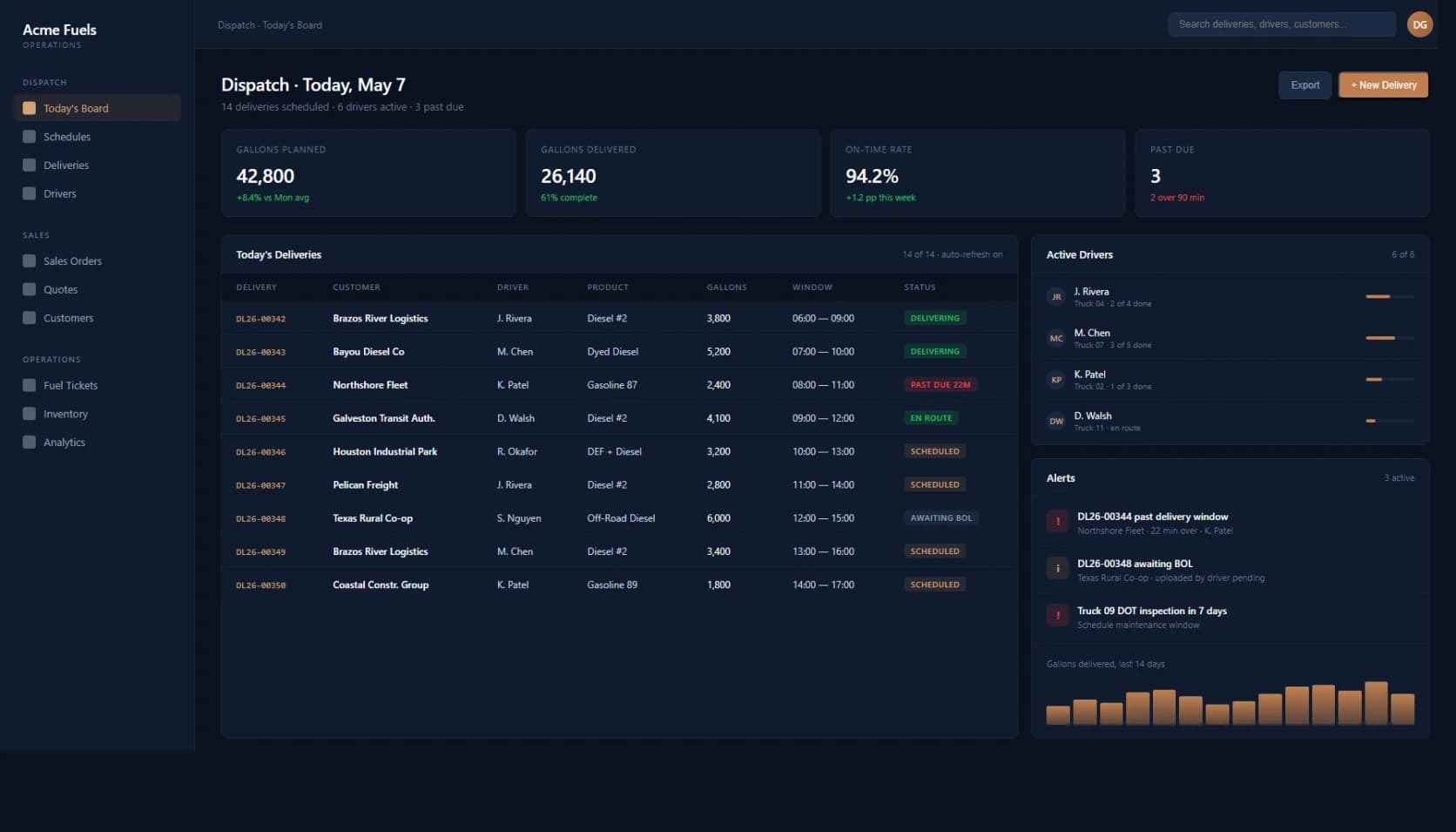
Paper, phones, and end-of-day scrambles
- Paper fuel delivery tickets captured gallons and signatures in the field
- Dispatch happened over the phone — no real-time view of who was where
- Billing was a manual end-of-day run against stacks of paperwork
- No reliable on-time data, no compliance expiry tracking, no audit trail
One connected platform, four portals
- Ops portal with live dispatch, real-time GPS, and a prioritized alert panel
- Mobile driver portal for tank readings, meter photos, and on-screen signatures
- Customer portal for self-serve delivery tracking, invoice download, and document upload
- Public site with a quote request form that feeds straight into the ops portal as a ready-to-convert quote
- Same-day invoicing tied to completed deliveries, with every change captured in a system-wide audit log
What's actually running in production
Concrete operational facts from the platform Orbit Fuels uses every day.
Ops, mobile driver, self-serve customer, and the public marketing site all read and write to the same source of truth.
Pending, Assigned, En Route, Arrived, In Progress, Pending Review, Completed, Failed, Cancelled, and Voided — each state change captured with timestamp and actor.
Every active driver pings location every 30 seconds, with 2-minute history snapshots persisted for the activity timeline and route playback.
Any delivery where actual gallons diverge from planned by more than 10% is routed for admin review before billing.
Weather, Driver Unavailable, Vehicle Breakdown, Road Closure, Site Not Ready, Supply Shortage, Safety Concern, Scheduling Conflict, Permit Hold, Dispatch Error, Holiday Closure, Customer Request, or Other — required selection plus notes, all written to delivery history.
CDL, HazMat endorsement, TWIC, medical card, drug test, and background check expirations surface on the dispatcher alert panel.
Ethanol-blended gasoline (regular 87, mid 89, premium 92/93), non-ethanol gasoline (regular 87, premium 90), ULSD clear and red-dyed diesel, and DEF — each priced and tracked per delivery, with lubricants and additional products supported by the catalog.
Edits to orders, deliveries, pricing, drivers, and credentials are captured with who, when, and the prior value — exportable for compliance review.
How we built it, stage by stage
Four stages applied to fuel delivery operations.
We shadowed dispatch and mapped the driver workflow
Before writing any code, we mapped how fuel actually moves: from a customer quote request, through a sales order, through delivery scheduling, to driver execution, to fuel delivery tickets, to invoicing. We documented every delivery state, every sales order state, and every compliance document a DOT fuel carrier needs in order to operate. The client reviewed and approved our process documentation before we touched the system.
Four portals, one database, one lifecycle
We designed a four-portal architecture around the way the operation actually ran — a public marketing site where prospects request quotes, an ops portal for dispatchers and admins, a driver portal for field execution, and a customer portal where existing customers self-serve their orders, deliveries, invoices, and documents. The data model unified sales orders, deliveries, fuel delivery tickets, drivers, contractors, customer records, and compliance credentials under a single lifecycle. Every sales order could fan out into multiple deliveries; every delivery produced a compliance ticket; every ticket rolled up to an invoice; every invoice and document was visible to the customer the moment it was created.
Live in production across four portals
We shipped a working platform with a real-time dispatch dashboard showing gallons planned vs. delivered, unassigned deliveries, active drivers with live GPS, and a prioritized alert panel for past-due deliveries and expiring credentials. Drivers got a mobile portal for capturing tank readings, signatures, and meter photos. Customers got a self-service portal for tracking deliveries, downloading invoices, uploading tax and insurance documents, and submitting categorized support requests. Admins got analytics with on-time rate, revenue, and gallons trends, plus a system-wide audit log capturing every change. Operations went live with real dispatchers, real admins, real drivers, and real customers — not a prototype.
Monthly sprints, continuous improvement
Since launch we've shipped multiple rounds of improvements — workflow refinements, security hardening, analytics enhancements, and quality-of-life fixes for dispatchers, drivers, and admins. Every month the platform gets better because we stay embedded in the operation.
Every part of the operation, in one system
Dispatch, field execution, compliance, billing, and analytics — connected end-to-end.
Dispatch & Fleet
- Real-time dashboard with planned vs. delivered gallons
- Live driver GPS map with online detection
- Multi-stage delivery lifecycle covering the full journey from scheduling to completion
- Reschedule workflow with required reason codes and audit trail
- Recurring schedules that auto-generate sales orders on any cadence
- Driver scorecards with reliability grade, on-time rate, total gallons, and failure rate
Sales & CRM
- Public quote request form on the marketing site
- Quote builder with supplier pricing, markup, and automated PDF generation
- Quote → sales order → delivery conversion flow
- Customer records with full order and delivery history
- Company records for contractor fleets with insurance and contract expiry tracking
Field Execution
- Driver mobile portal with a 5-step delivery progression — Assigned, En Route, Arrived, Delivering, Completed
- Optional before and after meter photo capture with timestamped upload
- Optional tank readings in inches before, after, and for water content — surfaced as fields on every delivery
- On-site product additions tagged with an "Added on-site" badge for admin reconciliation
- Customer signature captured directly on the driver's device (required at completion)
- Variance auto-flag — deliveries where actual gallons diverge from planned by more than 10% are routed for admin review
- Admin override for manually completing deliveries when the app can't be used in the field
Customer Portal
- Self-serve customer accounts via invite-only registration (no public signup)
- Real-time delivery tracking from dispatch through completion
- Invoice history with payment status, due dates, and overdue flags
- Document vault for tax forms, certificates of insurance, contracts, and permits
- Built-in support ticketing across six categories with reply threads
- Quote acceptance that queues a one-click admin conversion to a sales order — no phone call required
Finance & Compliance
- Multi-fuel product catalog covering gasoline, diesel, and DEF variants
- Invoicing tied directly to completed deliveries
- Configurable fee rules for base delivery fees, distance pricing, minimums, and per-product rules
- Driver credential tracking for CDL, HazMat, TWIC, medical, drug test, and background check
- Proactive credential expiry warnings across the fleet
- System-wide audit log capturing every change with before/after values
Analytics & Reporting
- Weekly ops report with week-over-week trends
- On-time delivery rate with colour-coded thresholds for quick scanning
- Revenue trends, delivery KPIs, and driver performance rankings
- Profitability analysis by customer, product, or route
The platform is currently running in production with Orbit Fuels.
Engineered for a DOT-regulated operation
Fuel delivery is one of the most heavily regulated logistics operations in North America. DOT, EPA, and state fire marshals all expect contemporaneous records of who handled what fuel, when, where, and under what credentials. We designed the platform around that reality from day one — not as a bolt-on.
Every fuel delivery ticket carries the compliance fields
Hazmat fields, tank readings (before, after, and water — captured when applicable), product line items, on-screen customer signatures, and timestamped meter photos. 6-digit sequential ticket numbers mirror the traditional paper-ticket book convention — same numbering scheme, digital-native record.
Credential expiry is proactive, not reactive
CDL number and class, HazMat endorsement, TWIC card, medical card, drug test, and background check are tracked per driver. Anything within 30 days of expiry is color-coded on the driver record and surfaces on the ops dashboard alert panel — so dispatchers see it at the moment they're choosing who to assign.
Audit log captures every change with before / after values
Reschedules require a categorized reason and notes. Voids require a reason and remain reversible — un-complete and restore are first-class actions, not database hacks. The audit log is searchable by user, date, and action type, and exportable for compliance review.
Variance and exception flagging by default
Deliveries with actual gallons more than 10% off plan are auto-flagged for admin review. On-site product additions are tagged "Added on-site" for reconciliation. Failed and cancelled deliveries roll into driver scorecards separately from completed work, so reliability grades stay honest.
Shipped since launch
Live in production since February 2026, evolving every month. Over 65 database migrations and monthly feature releases driven by what dispatchers, drivers, and customers ask for next — not by an internal roadmap.
- Four-portal platform went live (ops, driver, customer, public)
- QuickBooks Online integration with bidirectional sync
- Quote-to-sales-order email automation with branded PDF
- Customer support ticketing with categorized requests and conversation threads
- Live driver GPS on a real-time ops dashboard
- Weekly forecast calendar with TV-mode wall display for the ops floor
- Automated daily brief and 6 AM morning-attention email reports
- Recurring schedules with multi-product support
- In-portal driver training guide
- Reason-aware delivery cancellation with cascade traceability
- Maintenance module live: driver reporting + admin dashboard + web push notifications
- Multi-portal access — one user across ops, driver, and customer portals
- Customer self-service place-order flow
- Daily fuel-price email broadcast to opted-in customers
- Delivery void / restore / un-complete with full audit trail
Different industry, same method
Same four stages, applied to a global food & beverage PO automation pipeline. See the second case study, or tell us how your team works today.
Get My Custom Audit